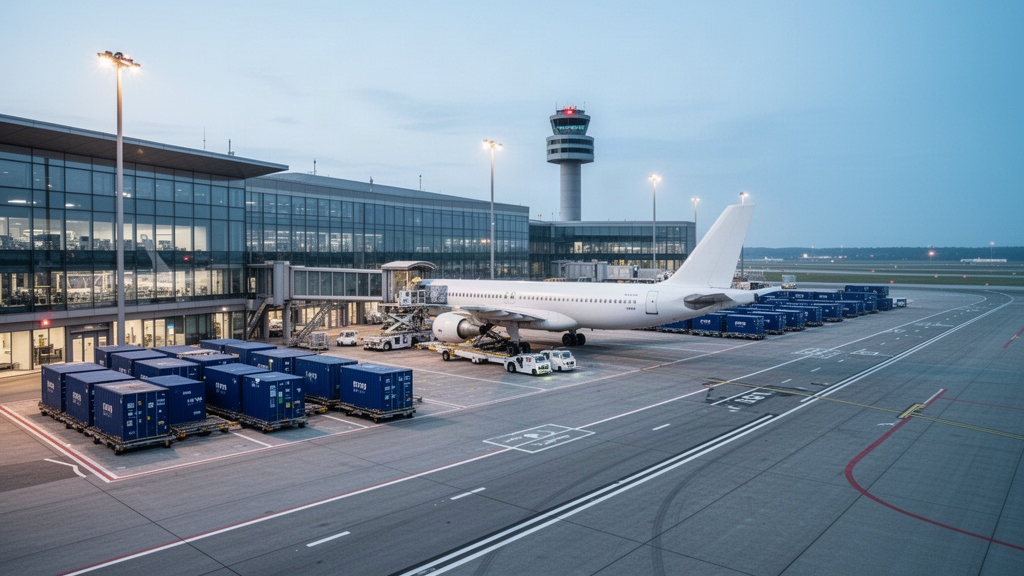
Aerospace companies do far more than build aircraft and launch satellites. They sit at the center of some of the most demanding logistics networks on the planet, moving high-value components across continents under tight regulatory oversight and even tighter deadlines. A delayed engine part can ground an entire fleet. A missing avionics component can stall a launch window worth hundreds of millions of dollars. According to IATA, air cargo revenues reached approximately $157 billion in 2025, and the sector handled around 61.2 million tonnes of freight that year. Much of that volume traces directly back to aerospace manufacturing and maintenance cycles. Understanding how these companies interact with global logistics is no longer a niche concern — it shapes how modern supply chains are designed, funded, and protected.
Why aerospace companies matter to global logistics
Air freight carries roughly 35% of world trade by value, despite representing a small share of total cargo volume. That imbalance exists largely because aerospace-related goods — turbine blades, avionics, composite panels, satellite components — are precisely the kind of high-value, time-sensitive items that cannot wait for a container ship. Boeing and Airbus each manage supply chains that stretch across dozens of countries, sourcing everything from titanium fasteners to full fuselage sections from specialized manufacturers worldwide.
The logistics demands of this sector differ sharply from conventional manufacturing. Certification requirements imposed by the FAA and ICAO mean that parts cannot simply be substituted or sourced from alternative suppliers without extensive re-qualification. Every component carries traceability documentation, and any break in that chain can trigger costly delays or grounding orders. This makes aerospace supply networks unusually rigid compared to, say, consumer electronics.
Airlines and cargo operators feel these pressures directly. When Pratt & Whitney or Collins Aerospace (both part of RTX) faces a production bottleneck, the ripple effects reach MRO providers, freight forwarders, and airlines within weeks. In 2024, air cargo accounted for approximately 20.8% of total airline revenues globally according to IATA — a figure that underlines how tightly passenger and freight operations are intertwined with aerospace manufacturing cycles.
Beyond commercial aviation, SpaceX, Northrop Grumman, and United Launch Alliance have introduced an entirely new logistics dimension: the movement of rocket stages, payload fairings, and satellite hardware under strict environmental controls and export regulations managed by the U.S. Department of Commerce's Bureau of Industry and Security. These shipments often require dedicated transport solutions that no standard freight carrier can provide off the shelf.
How aerospace companies shape supply chain performance
The influence of major aerospace manufacturers on supply chain design goes well beyond their own factory gates. Tier 1 suppliers like Lockheed Martin and RTX subsidiaries impose delivery standards, packaging specifications, and quality audits that cascade down through Tier 2 and Tier 3 vendors. A small machining shop in Ohio supplying landing gear brackets must meet the same documentation standards as a major engine manufacturer.
Read also: Why Ignoring 10 Years Treasury Yield Could Cost You
Several logistics requirements are specific to the aerospace sector and define how supply chains must be structured:
- Just-in-time delivery of components to assembly lines, where inventory buffers are minimal and line stoppages are extremely costly
- Spare parts logistics for MRO operations, where an aircraft-on-ground (AOG) situation demands same-day or next-flight delivery regardless of location
- Time-critical shipments tied to launch windows or scheduled maintenance checks, where there is no flexibility in the delivery date
- Dangerous goods handling, including lithium-ion batteries subject to IATA classification, packaging, and documentation rules that vary by battery chemistry and charge state
- Export control compliance under U.S. Customs and Border Protection and Bureau of Industry and Security regulations, which can delay or block shipments entirely if documentation is incomplete
Digital supply chain platforms have become standard tools for managing this complexity. Real-time tracking of components, automated customs pre-filing, and predictive analytics for lead time management are now baseline expectations rather than competitive advantages. Companies that cannot provide full component traceability risk losing contracts with prime contractors entirely.
The MRO segment alone generates enormous logistics activity. Airlines collectively operate thousands of aircraft requiring scheduled and unscheduled maintenance, and the global network of approved MRO providers depends on a continuous flow of certified parts. FedEx, UPS, and DHL Group have all developed dedicated aerospace logistics divisions to serve this demand, offering temperature-controlled storage, AOG priority services, and bonded warehousing at major hub airports.
The logistics technologies transforming the sector
Digitization has reshaped how aerospace supply chains operate at every level. IoT-enabled tracking devices now monitor components throughout transit, recording temperature, humidity, shock exposure, and location in real time. For sensitive avionics or composite materials that can be damaged by moisture or vibration, this data directly affects whether a part is accepted or rejected upon arrival.
Predictive analytics tools allow supply chain managers to anticipate demand spikes before they materialize. By analyzing maintenance records, flight hours, and historical failure rates, airlines and MRO providers can pre-position spare parts at the right locations rather than reacting to shortages after the fact. This shift from reactive to anticipatory logistics has measurably reduced AOG events for carriers that have fully implemented these systems.
Read also: Vxus: The Digital Transformation Every Business Needs
Additive manufacturing — commonly called 3D printing — is beginning to change the spare parts model for older aircraft types. Instead of maintaining physical inventories of rarely-needed components, some operators now store digital design files and print parts on demand at certified facilities near the point of use. Boeing has been active in qualifying printed parts for non-structural applications, and the FAA has developed certification pathways to support this approach.
Warehouse automation at major aerospace logistics hubs has also accelerated. Robotic picking systems, automated storage and retrieval, and AI-driven inventory management reduce handling errors and speed up order fulfillment. These investments are particularly visible at the large distribution centers operated by integrators like DHL Group near airports in Louisville, Cincinnati, and Leipzig.
The risks behind aerospace supply networks
The same characteristics that make aerospace supply chains precise also make them fragile. Single-source dependencies are common: certain composite materials, specialized alloys, or certified sub-assemblies may have only one or two qualified global suppliers. When that supplier faces a fire, a labor dispute, or a quality hold, the entire downstream network stalls.
Geopolitical tensions have added a new layer of uncertainty. Export control regulations administered by the U.S. Bureau of Industry and Security can change rapidly, restricting the movement of specific technologies to certain destinations or end users. Companies that relied on single sourcing strategies without geographic diversification found themselves exposed when trade restrictions tightened in recent years.
Cybersecurity has emerged as a serious operational risk. Aerospace supply chains rely on shared digital platforms, electronic data interchange systems, and connected factory equipment. A ransomware attack on a Tier 2 supplier can disrupt production schedules at prime contractors within days. The Transportation Security Administration has issued specific guidance on freight cybersecurity, and the FAA maintains ongoing oversight of digital systems in certified aircraft.
Read also: What You Need to Know About Agriculture for Business Success
Certification constraints add another layer of risk that has no equivalent in most other industries. A part that fails an inspection cannot simply be replaced with an equivalent from a different supplier — it must be re-qualified, a process that can take months. This regulatory rigidity, while necessary for safety, means that supply chain resilience in aerospace requires far more advance planning than in sectors where substitution is straightforward.
What the future holds for aerospace-driven logistics
Several structural shifts are already visible and will define the sector over the next several years. Decarbonation is pressing manufacturers and logistics providers alike: sustainable aviation fuel supply chains, lighter composite structures, and electric ground support equipment all require new logistics infrastructure and supplier relationships that are still being built.
The growth of commercial space activity is opening an entirely new logistics frontier. As SpaceX, ULA, and emerging launch providers increase launch cadence, the movement of payloads, propellants, and ground support equipment between manufacturing sites and launch facilities is becoming a repeatable logistics challenge rather than a one-off operation. Specialized transport providers are already positioning to serve this demand.
Nearshoring and supplier diversification are reshaping where aerospace components are made. Following the supply disruptions of the early 2020s, prime contractors accelerated efforts to qualify additional suppliers and reduce dependence on single geographic regions. This diversification improves resilience but increases the complexity of quality management and logistics coordination across a wider supplier base.
Drone delivery for spare parts at remote maintenance bases and offshore platforms is moving from pilot programs to operational deployment. The FAA's evolving framework for beyond visual line of sight (BVLOS) operations is gradually enabling commercial use cases that aerospace logistics providers have been preparing for years. When combined with additive manufacturing and predictive maintenance, these tools point toward a logistics model where physical inventories shrink and response times compress simultaneously — a combination that would have seemed implausible a decade ago.