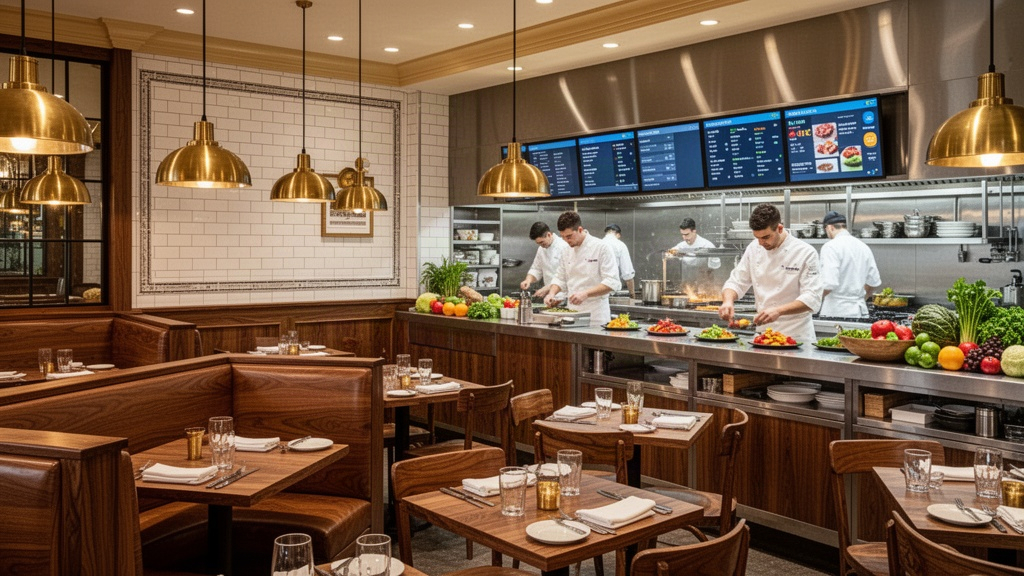
Running a restaurant chain means operating at scale, and scale creates friction the moment someone proposes change. Every menu update, service redesign or technology rollout touches dozens or hundreds of locations simultaneously. The pressure to protect brand consistency and unit economics pushes operators toward caution. Yet standing still is its own risk. Guest expectations shift, labor markets tighten, and competitors move faster than legacy systems allow. The chains that grow steadily are not the ones that avoid innovation — they are the ones that have learned to test ideas without destabilizing the network. This requires a structured approach: identifying where change is safe to try, building low-risk pilots, securing alignment across franchisees and suppliers, and turning individual experiments into repeatable systems that the whole organization can absorb.
Why innovation is difficult inside a traditional restaurant chain
The tension is structural. A restaurant chain derives its competitive advantage from consistency: the same product, the same service speed, the same cost structure, replicated reliably across every location. That consistency is what allows the brand to make promises to customers and deliver on them. Any change threatens to break that promise somewhere in the network, and that risk is not theoretical.
Add a new menu item and you immediately create pressure on ingredient procurement, kitchen layout, staff training and allergen labeling. In the United States, the FDA requires calorie disclosure on chain menus with 20 or more locations; in the UK, the Food Standards Agency enforces strict allergen communication rules. A single poorly managed rollout can create compliance exposure across the entire estate.
The financial structure of the chain adds another layer of difficulty. Food cost, labor cost and occupancy are tightly managed ratios. An innovation that improves guest satisfaction but degrades unit margin by two percentage points is not a success at scale — it is a network-wide problem. Finance teams are right to scrutinize proposals carefully.
Franchisee relationships create a third constraint. Independent operators who have invested their own capital expect stability and predictability. Frequent changes to equipment requirements, supplier lists or service protocols can erode trust and generate resistance. The Federal Trade Commission governs franchise disclosure obligations in the US, and franchise agreements typically define the conditions under which the franchisor can mandate operational changes. Legal and relational boundaries are real.
None of this means innovation should stop. It means innovation must be designed with the system in mind from the start, not bolted on afterward.
Where a restaurant chain can innovate without losing consistency
Not all parts of the operation carry equal risk. Some areas absorb change well; others can destabilize the network if touched carelessly. Identifying the right domains is the first practical decision any innovation team must make.
Read also: What You Need to Know About Agriculture for Business Success
Digital ordering and loyalty programs are among the lowest-disruption areas. They sit at the customer interface without requiring physical changes to kitchens or equipment. Mobile apps, self-order kiosks and integrated loyalty platforms can be piloted at select locations, measured against same-store sales benchmarks and rolled out progressively. The operational footprint is manageable.
Menu innovation carries more risk but remains a strong lever when scoped correctly. Limited-time offers allow chains to test new flavors, formats or dietary options without committing to permanent procurement changes. A plant-based protein, a regional flavor variant or a premium tier can all be evaluated through a controlled menu extension before any permanent decision.
Operational formats offer significant headroom. Ghost kitchens, smaller-footprint express units and drive-through-only formats have allowed several chains to reach new trade areas without the capital intensity of a full traditional site. These are not minor tweaks — they are genuine format experiments — but they can be structured as standalone pilots with ring-fenced budgets.
Sustainability and waste reduction represent another domain where innovation aligns with both cost and brand objectives. Reviewing portion sizes, renegotiating packaging with suppliers or trialing food donation partnerships can be tested locally, measured on food cost and waste metrics, and scaled where results hold.
Build a low-risk pilot before scaling the idea
A well-designed pilot is the single most effective tool for managing innovation risk inside a complex network. The goal is to verify a commercial or operational hypothesis with a limited investment before committing the broader system.
Start with a clear hypothesis. Not "let's try a new burger," but "adding a plant-based option to the lunch menu at urban locations will increase average ticket by 8% without extending service time beyond three minutes." Specificity makes the test measurable and the decision criteria defensible.
Read also: What is financial education: essential insights for every business
Select pilot sites deliberately. A single pilot store in an atypical location produces misleading data. A set of three to five sites that represent different trade formats — urban, suburban, high-traffic, mid-volume — gives results that travel better across the network. Pair each test site with a comparable control site that receives no change.
Define the metrics before the test begins:
- Same-store sales versus the control group over the same period
- Average ticket and attachment rate for the new item or service
- Food cost percentage and waste volume
- Labor cost and service time during peak hours
- Customer return rate tracked through loyalty data or transaction frequency
- Staff feedback on operational complexity
Run the pilot long enough to account for seasonality and novelty effects. A four-to-six-week window often captures the initial excitement but misses the steady-state behavior that matters for a permanent rollout decision. Define stopping criteria in advance: if food cost exceeds a set threshold or service time degrades beyond an agreed ceiling, the test ends regardless of other results.
The stage-gate process provides a useful governance structure here. Each gate forces an explicit decision — continue, modify or stop — based on evidence rather than enthusiasm.
Align franchisees, staff and suppliers around the change
Technical validation is necessary but not sufficient. A concept that tests well operationally can still fail at rollout if the people who must execute it are not genuinely prepared.
Franchisees are the first audience to engage. Operators who understand the rationale behind a change, who have seen the pilot data and who have had a voice in refining the execution are far more likely to implement it faithfully. Franchise advisory councils, regional operator meetings and early-adopter programs that invite select franchisees into the pilot phase all reduce resistance downstream. The investment in consultation pays back in rollout quality.
Read also: What are the bonds and how they influence interest rates
Front-line staff carry the change at the moment of truth. Training must be specific, practical and delivered close to the implementation date. Abstract brand messaging does not help a crew member explain a new allergen to a guest or operate a new piece of equipment during a lunch rush. ServSafe-aligned training materials and hands-on practice sessions in the pilot locations before broader deployment are minimum requirements in the US market.
Supplier alignment is frequently underestimated. A new ingredient that works brilliantly in a test kitchen may become a supply chain problem at volume. Engage key suppliers during the pilot phase, not after the rollout decision. Confirm lead times, minimum order quantities and contingency sourcing options before committing the network. The USDA Food Safety and Inspection Service standards apply to meat and poultry products regardless of innovation context — compliance cannot be retrofitted.
Measure results and create a repeatable innovation system
A single successful pilot is an anecdote. A system that consistently generates, tests and scales improvements is a competitive advantage.
After each pilot, document the full cycle: the hypothesis, the test design, the results against each metric, the decision taken and the lessons that would change the next test design. This documentation is not bureaucratic overhead — it is the institutional memory that prevents the organization from repeating the same mistakes as team members change.
Use the stage-gate framework to create predictable decision points. Innovation teams should know exactly what evidence is required to move from concept to pilot, from pilot to limited rollout, and from limited rollout to full network deployment. Clear criteria reduce political friction and speed up decisions.
Build a cross-functional innovation team that includes operations, marketing, finance and technology from the start. Ideas that originate in marketing without operations input generate beautiful concepts that break in the kitchen. Ideas that originate in operations without marketing input solve internal problems that guests never noticed.
Treat the pipeline as a portfolio. Some experiments will fail — that is the expected outcome of genuine testing, not a sign that the process is broken. A healthy innovation pipeline for a mid-size chain might include two or three active pilots at any given time, with clear criteria for what moves forward and what stops. The discipline to stop underperforming tests quickly is what keeps resources available for the ideas that actually work.