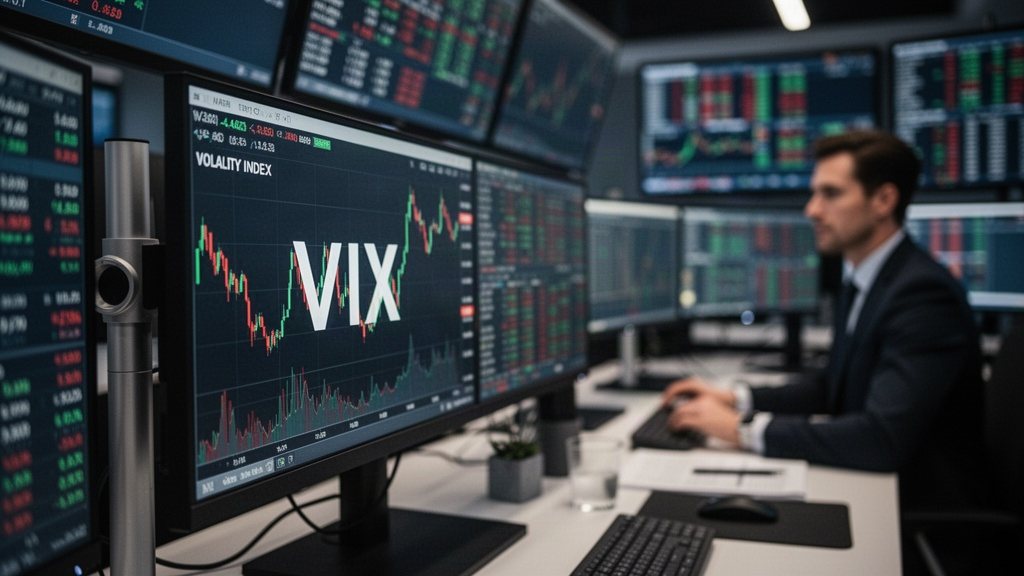
Fear is one of the most underestimated forces in financial markets. Whether you are a seasoned institutional investor or a retail trader placing your first options order, emotional decision-making can derail even the most carefully constructed strategy. Understanding vix stock behavior gives traders a measurable, data-driven window into collective market anxiety. The CBOE Volatility Index, commonly known as the VIX, translates the implied volatility of S&P 500 options into a single number that tells you, in real time, how nervous the market really is. When that number climbs, fear is winning. When it drops, confidence returns. Learning to read and respond to VIX signals is one of the most practical steps any trader can take to stop reacting emotionally and start acting strategically.
What the VIX Stock Index Actually Measures
The VIX was created by the Chicago Board Options Exchange (CBOE) and first published in 1993. It measures the market's expectation of 30-day volatility by analyzing the pricing of a wide range of S&P 500 index options, both calls and puts. When traders are anxious about near-term price swings, they pay more for options protection, and that elevated demand pushes the VIX higher. A calm, trending market does the opposite.
Numerically, a VIX reading below 15 signals low volatility and broad investor confidence. Readings between 15 and 25 reflect moderate uncertainty. Once the index breaks above 30, markets are in a state of elevated fear, and historical data confirms that these spikes often coincide with sharp equity sell-offs, geopolitical shocks, or sudden liquidity crunches. The VIX averaged 20.54 in 2025, a figure that reflects a market navigating genuine macroeconomic headwinds without tipping into full panic.
Traders sometimes confuse the VIX with a directional indicator. It is not. A high VIX does not tell you whether stocks will go up or down; it tells you that large moves in either direction are expected. That distinction matters enormously when building a trading plan. Retail traders who misread VIX spikes as automatic sell signals often exit positions at exactly the wrong moment, locking in losses just before a recovery.
The index also has a mean-reverting character. Extreme readings above 40 or 50, like those seen during the 2008 financial crisis or the March 2020 pandemic shock, have historically been followed by sharp declines back toward the long-run average. Recognizing this pattern gives disciplined traders a structural edge. Institutional investors have long used VIX derivatives to hedge portfolios, and understanding the same mechanics helps retail participants think more like professionals rather than reacting to headlines.
How Fear Rewires Trading Decisions
Fear does not arrive with a warning label. It enters a trading session quietly, through a red candlestick, a troubling earnings report, or a single alarming headline. Before the rational mind can evaluate the information, the emotional brain has already begun pushing toward one conclusion: get out. This biological response, hardwired over thousands of years of survival instinct, is genuinely hostile to profitable trading.
Loss aversion, a concept documented extensively in behavioral finance research, explains why traders feel the pain of a $1,000 loss roughly twice as intensely as the pleasure of a $1,000 gain. This asymmetry leads to predictable errors: cutting winning trades too early to lock in small gains, holding losing trades too long in the hope of a recovery, and avoiding re-entry after a stop-out even when the original thesis remains valid.
The VIX amplifies these tendencies. When the index spikes suddenly, it creates a feedback loop. Traders see volatility rising, feel fear, sell positions, which drives prices lower, which pushes volatility higher still. Panic selling cascades are not random events; they are the collective output of thousands of fear responses happening simultaneously. Understanding that you are operating inside this system is the first step toward not being controlled by it.
There is also the phenomenon of volatility aversion, where traders systematically underweight opportunities that appear during high-VIX environments simply because the environment feels uncomfortable. Historically, some of the strongest short-term recovery rallies have occurred when the VIX was at its highest, precisely because sentiment had become so uniformly negative that any positive surprise produced outsized price moves. Traders who avoid the market entirely during these windows miss asymmetric opportunities.
Recognizing fear as a market-wide, measurable phenomenon rather than a personal weakness changes the psychological dynamic. The VIX does not judge. It simply reports what the collective options market is pricing. When you can externalize fear into a number on a chart, it becomes data rather than emotion, and data can be analyzed, planned around, and ultimately used.
Strategies to Overcome Trading Fears Using Market Signals
Managing fear in trading requires both structural preparation and real-time discipline. Having a plan before volatility arrives is far more effective than trying to think clearly while a position moves against you. The following practices directly address the psychological vulnerabilities that the VIX exposes:
- Define your VIX thresholds before entering any trade. Decide in advance how your position sizing or hedging strategy changes when the VIX crosses 20, 30, or higher. Written rules remove in-the-moment discretion.
- Use the VIX to size positions, not to avoid them. Higher volatility means wider price swings, which means smaller position sizes are needed to keep risk constant. Reducing size during high-VIX periods is a mechanical adjustment, not a fear response.
- Track your emotional state alongside your trade journal. Noting how you felt when you entered and exited trades reveals patterns between emotional states and poor decision quality.
- Build a volatility watchlist. Monitor VIX-related products such as VXX or UVXY alongside your core positions. Seeing volatility instruments move in real time contextualizes sudden price action in your portfolio.
- Practice scenario rehearsal. Before each trading session, mentally walk through what you will do if the VIX spikes 5 points during the day. Pre-committed responses reduce freeze responses when actual volatility hits.
Beyond these tactical steps, systematic exposure to volatile market conditions, through paper trading or reduced live size, builds genuine psychological resilience. Traders who have lived through multiple VIX spikes without catastrophic losses develop a reference library of experience that makes future spikes feel manageable rather than existential.
Working with a defined risk-reward ratio on every trade also reduces fear by eliminating ambiguity. When you know exactly how much you are willing to lose before entering a position, the decision to exit a losing trade becomes a mechanical execution rather than an emotionally charged capitulation. The VIX environment informs the size of that acceptable loss, but the structure itself remains constant.
Where VIX Stock Signals Are Heading Next
The role of the VIX in modern markets continues to grow more nuanced. As of 2026, the proliferation of zero-day options (0DTE) has introduced new complexity into how the index captures short-term fear. These contracts, which expire within a single trading session, generate enormous options volume that interacts with VIX methodology in ways that researchers and practitioners are still mapping. The CBOE has acknowledged this evolution and continues to refine its calculation approach.
Algorithmic and high-frequency trading systems now respond to VIX levels automatically, creating faster feedback loops between volatility readings and market execution. What once took hours to manifest in price action can now unfold in minutes. Retail traders who understand this dynamic position themselves to recognize VIX-driven moves as mechanical rather than fundamental, which prevents the misattribution of algorithmic activity to genuine economic deterioration.
There is also growing interest in sector-specific volatility indices that apply the VIX methodology to individual industries such as energy, technology, and financials. These tools give traders a more granular picture of where fear is concentrated rather than relying solely on the broad market reading. Combining the headline VIX with sector volatility data produces a richer analytical framework.
The psychological dimension of trading will never disappear. Markets are human systems, and humans bring anxiety, greed, and uncertainty into every session. What changes is the quality of the tools available to measure and respond to those emotions collectively. Traders who treat the VIX as a core analytical input, rather than background noise, are building a practice grounded in evidence rather than instinct. That shift, from reactive to deliberate, is where sustainable trading performance begins.