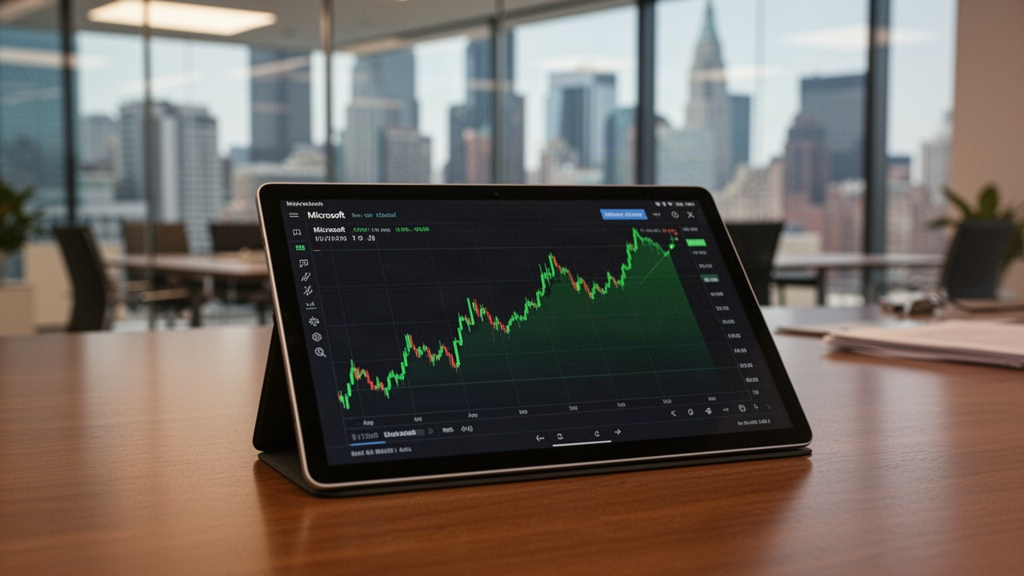
Apple Inc. remains one of the most closely watched companies on global financial markets, and understanding the stock price Apple computer trajectory has become a priority for both institutional and retail investors. As the tech giant continues to push into new product categories and expand its services ecosystem, its share price reflects not just hardware sales but a broader strategic evolution. Trading on the NASDAQ under the ticker AAPL, Apple's valuation is shaped by product cycles, macroeconomic conditions, and competitive dynamics that shift faster than most industries. This analysis cuts through the noise to examine where Apple's stock stands today, what forces are moving it, and what investors should realistically expect as 2026 unfolds.
Current Trends in Apple's Stock Performance
Apple's stock has demonstrated a pattern of resilience that consistently surprises skeptics. Despite supply chain disruptions and a challenging interest rate environment in prior years, AAPL has maintained strong upward momentum driven by consistent earnings beats and robust share buyback programs. The company's ability to generate free cash flow at scale gives it a financial cushion that few technology companies can match.
The services segment now accounts for a growing share of total revenue, and markets have rewarded this shift. Apple's gross margin on services runs significantly higher than on hardware, which means every dollar shifted toward subscriptions, the App Store, and iCloud improves overall profitability. Investors tracking earnings per share (EPS) have watched this metric climb steadily, reinforcing confidence in the stock.
Wearables and accessories have quietly become a multi-billion-dollar business. The Apple Watch and AirPods lines alone generate revenue comparable to many Fortune 500 companies. This diversification reduces the stock's vulnerability to iPhone supercycle volatility, which previously caused sharp quarterly swings in share price.
Analyst consensus from sources including Bloomberg and Yahoo Finance points to a stock trading range that reflects both optimism about AI integration and caution about premium device saturation in mature markets. Short-term price movements will continue to track iPhone launch cycles, but the longer-term trend is anchored to services growth and margin expansion. The stock's price-to-earnings ratio has historically commanded a premium over the broader S&P 500, and that premium appears sustainable given the company's balance sheet strength and brand loyalty.
One angle that deserves attention is Apple's aggressive capital return program. The company has repurchased hundreds of billions of dollars in shares over the past decade, mechanically reducing the float and supporting earnings per share even in periods of flat net income growth. This makes AAPL behave differently from pure growth stocks, offering a quasi-dividend effect that attracts conservative institutional money.
Factors Influencing the Apple Computer Stock Price
No single variable moves Apple's share price in isolation. The stock responds to a web of interconnected forces, and understanding them separately is the first step toward making informed investment decisions.
- iPhone upgrade cycles: A new hardware generation with meaningful feature differentiation drives short-term revenue spikes and tends to push the stock higher in the months surrounding launch.
- Services revenue growth: Each percentage point of growth in the App Store, Apple Music, and Apple TV+ directly improves margin profiles and justifies a higher earnings multiple.
- Artificial intelligence integration: Apple's on-device AI capabilities, branded under Apple Intelligence, are now a competitive differentiator that analysts factor into forward estimates.
- Federal Reserve policy: Interest rate decisions affect the discount rate applied to future earnings. Higher rates historically compress tech valuations; rate cuts have the opposite effect.
- China market exposure: Roughly 18-20% of Apple's revenue comes from Greater China, making geopolitical tensions and local competition from brands like Huawei a persistent risk variable.
Regulatory pressure from the Department of Justice and the European Commission regarding App Store practices adds a layer of uncertainty. Forced changes to commission structures could shave meaningful revenue from the services segment, and markets price that risk into the stock even before any ruling takes effect.
Supply chain geography is another factor that has moved from background noise to front-page concern. Apple's ongoing effort to diversify manufacturing toward India and Vietnam reduces concentration risk but introduces transition costs. Investors who track operational efficiency metrics will monitor how this shift affects gross margins over the next several quarters.
Currency fluctuations matter more than many retail investors realize. Because Apple reports in US dollars but generates a large share of revenue internationally, a strengthening dollar mechanically reduces reported revenue even when underlying demand stays flat. Hedging strategies partially offset this, but the effect is never fully neutralized.
What Projections Suggest About Apple's Valuation
Apple's market capitalization reached approximately $2.5 trillion, a figure supported by significant growth in both services and wearables. This positions Apple among the most valuable companies ever recorded by market cap, and sustaining that valuation requires continued execution on multiple fronts simultaneously.
Analyst price targets for AAPL in 2026 cluster around the $200 to $250 range, though these figures carry meaningful uncertainty and should be treated as directional rather than precise. The wide range reflects genuine disagreement about how quickly AI-driven features will translate into hardware upgrade demand and how regulatory outcomes will affect services margins.
Earnings per share projections, a more reliable valuation anchor than price targets, suggest continued mid-single-digit to low-double-digit annual growth. If Apple delivers EPS growth at the higher end of that range, current price levels look reasonable. A slowdown in services growth or an unexpected iPhone demand miss could compress the multiple and push the stock toward the lower end of analyst ranges.
The company's entry into spatial computing through Apple Vision Pro represents a long-duration bet. Revenue contribution in 2026 remains modest relative to total company revenue, but the platform's development trajectory will influence how investors assign a future growth premium to the stock. Early developer adoption metrics will be watched closely as a leading indicator.
One projection that often gets overlooked is the compounding effect of share buybacks on per-share metrics. Even with flat net income, a sustained buyback program at current rates will continue to grow EPS mechanically, providing a floor under the stock's valuation that pure growth-focused analysis tends to undercount.
Practical Approaches for Investors Watching AAPL
Owning Apple stock is not a monolithic decision. The right approach depends on investment horizon, risk tolerance, and existing portfolio concentration in technology. For long-term investors with a horizon beyond five years, AAPL's combination of cash generation, buybacks, and platform stickiness makes it a defensible core holding even at premium valuations.
Shorter-term traders often use options strategies around earnings announcements and product launch events. Implied volatility tends to spike before these catalysts and collapse afterward, creating opportunities for strategies that profit from volatility compression rather than directional price moves. This requires familiarity with derivatives mechanics and carries risks that casual investors should not underestimate.
Dollar-cost averaging remains the most straightforward approach for investors who believe in Apple's long-term direction but want to reduce the risk of buying at a cyclical peak. Spreading purchases across quarterly earnings cycles captures both high and low points in the stock's natural rhythm, lowering the average cost basis over time without requiring precise market timing.
Portfolio concentration deserves honest attention. Apple already represents a large weight in most broad market index funds, meaning passive investors already hold meaningful AAPL exposure through S&P 500 or total market funds. Adding a significant individual position on top of that creates sector concentration that amplifies both gains and losses relative to a diversified benchmark.
Monitoring a handful of specific metrics each quarter will give investors a clearer signal than headline revenue numbers alone. Watch services revenue growth rate, iPhone average selling price, and the pace of share repurchases. These three data points collectively tell the story of whether Apple's premium valuation is being earned or stretched. When all three trend favorably simultaneously, the stock historically outperforms. When two or more disappoint, the market reaction tends to be swift and disproportionate to the fundamental shortfall.