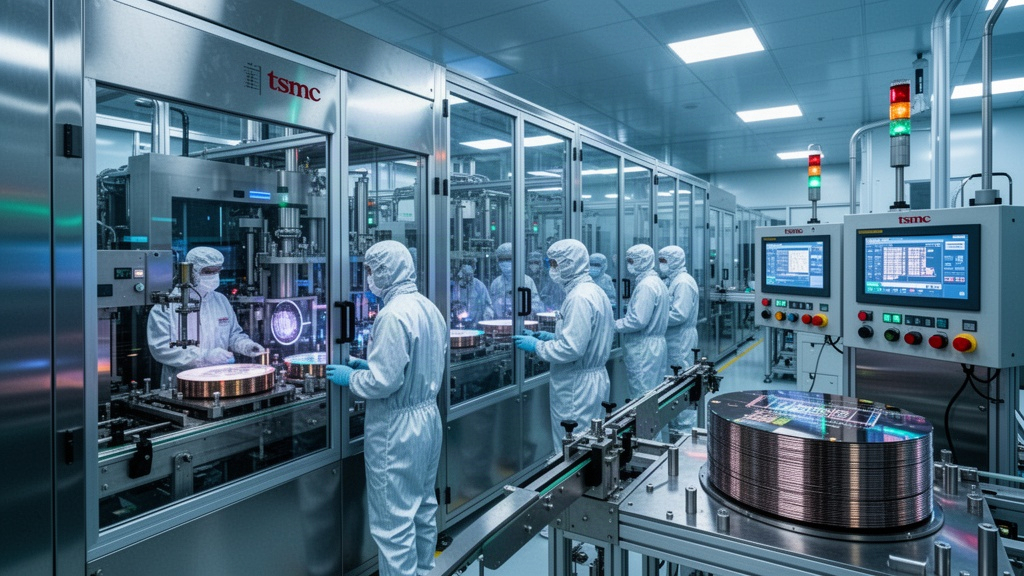
TSMC Taiwan Semiconductor Manufacturing Company sits at the center of the global technology supply chain, yet most consumers have never heard its name. Founded in 1987 by Morris Chang in Hsinchu, Taiwan, the company pioneered a manufacturing model that reshaped the entire semiconductor industry. Every time someone uses an iPhone, an AI server, or a modern car, there is a strong chance TSMC made the chips inside. With annual revenue reaching approximately 2,894 billion New Taiwan dollars in 2024 and a gross margin above 56%, the company has built a financial profile that rivals the world's most profitable industrial businesses. Understanding how TSMC operates, who it serves, and where it is heading matters for technology investors, supply chain professionals, and anyone tracking global economic power.
How TSMC's Pure-Play Foundry Model Defines the Semiconductor Industry
Most technology companies either design chips or manufacture them. TSMC made a deliberate choice to do only one: manufacture. This is what the industry calls a pure-play foundry model. TSMC never competes with its own customers by selling branded processors. Instead, it provides fabrication capacity to companies that design chips but lack the capital or expertise to build their own factories.
The distinction matters enormously. A chip designer like Apple or NVIDIA can invest billions in research and development without also spending tens of billions on manufacturing equipment. TSMC absorbs that capital burden, spreads it across dozens of customers, and operates its facilities at high utilization rates. The result is a mutually reinforcing relationship: designers get access to world-class fabrication, and TSMC gets a steady stream of high-volume orders from the most innovative companies on earth.
This model also creates a structural moat. Switching foundries is not a simple decision. A chip designed for TSMC's process technology requires significant re-engineering to run on a competitor's node. Customers invest years validating their designs on a specific process, which makes them deeply reluctant to move. AMD, Qualcomm, and MediaTek have all built their product roadmaps around TSMC's capabilities, which gives the Taiwanese company unusual pricing power and long-term contract visibility.
The financial results confirm the model's strength. A gross margin above 56% in 2024 is extraordinary for a capital-intensive manufacturer. Most industrial companies operate at a fraction of that level. TSMC achieves it by combining massive scale with process leadership, charging premium prices for nodes that no competitor can yet match at equivalent yield.
The Engineering Edge: Advanced Nodes, EUV Lithography, and Packaging
Process technology is where TSMC's competitive advantage becomes most tangible. The company entered volume production of its 3-nanometer node in the second half of 2022, ahead of every competitor. By around 2025, it began ramping volume production of its 2-nanometer generation, a process that demands extreme precision at every step of fabrication.
Read also: What are the bonds managing risks in uncertain markets
These node names are commercial designations rather than literal physical measurements. What they represent is a new generation of transistor density, power efficiency, and performance. Each new node requires extreme ultraviolet lithography, or EUV, a technology supplied almost exclusively by Dutch equipment maker ASML. EUV machines cost over 150 million dollars each and require years of installation and calibration. TSMC operates one of the largest EUV fleets in the world, a position that took years of investment to reach and cannot be replicated quickly.
Yield is the metric that separates leading foundries from the rest. Getting a high proportion of functional chips from each silicon wafer requires not just the right equipment but deep process knowledge accumulated over thousands of production runs. TSMC's yield rates on advanced nodes are widely regarded as superior to those of its nearest competitors, which translates directly into lower cost per functional chip for its customers.
Beyond raw lithography, TSMC has invested heavily in advanced packaging technologies such as CoWoS and SoIC, which allow multiple chiplets to be integrated in a single package. This capability is now central to the AI chip supply chain, where products from NVIDIA and others require stacking high-bandwidth memory alongside compute dies. Packaging has become a second dimension of competitive differentiation, not merely a finishing step.
The Customers and Markets Powering Sustained Revenue Growth
TSMC's revenue base spans four major demand categories. Smartphones have historically been the largest segment, driven by Apple's A-series and M-series chips along with processors from Qualcomm and MediaTek. These products require the most advanced nodes, which is why mobile computing pushed TSMC to develop its leading-edge processes in the first place.
High-performance computing has grown to rival smartphones in revenue contribution. Data center processors, AI accelerators, and network chips all fall into this category. The surge in demand for AI infrastructure since 2023 has been a direct tailwind for TSMC, as training and inference hardware requires chips built on the most advanced and expensive nodes available.
Read also: When Will Palantir Stock Reach New Heights in 2026
Automotive semiconductors represent a structurally growing segment. Modern vehicles contain hundreds of chips managing everything from powertrains to driver assistance systems. Automakers discovered during the 2021 shortage how exposed they were to foundry capacity constraints, and many have since signed longer-term agreements to secure supply. TSMC's automotive-grade processes are certified for the reliability standards that car manufacturers demand.
The Internet of Things and consumer electronics segment is less glamorous but adds volume and helps fill capacity across a range of mature nodes. TSMC operates fabs running processes from 28 nanometers down to 2 nanometers, and customers at every node contribute to its revenue base. This breadth protects the company from sharp downturns in any single market.
Global Expansion and the Geopolitical Dimension
For decades, TSMC concentrated nearly all advanced manufacturing in Taiwan, which created extraordinary efficiency but also concentrated geopolitical risk in a single location. That calculation has shifted. The company now operates or is developing production capacity in Taiwan, the United States, Japan, and mainland China.
The Arizona project is the most watched expansion. TSMC is building multiple fabs in Phoenix, with the U.S. Department of Commerce announcing preliminary support of up to 6.6 billion dollars in grants under the CHIPS and Science Act, alongside a proposed loan of up to 5 billion dollars. These figures remain subject to final agreement and verification against actual disbursements. The Arizona fabs are intended to produce advanced chips on U.S. soil, reducing dependence on Taiwan-based supply for American customers in defense and technology.
In Japan, TSMC's Kumamoto facility opened to serve automotive and industrial customers in a market that prizes supply chain proximity. A second Japanese fab is under development. These international sites carry higher operating costs than Taiwan, but they serve customers and governments willing to pay a premium for geographic diversification.
Read also: How VIX Stock Can Enhance Your Market Awareness Today
The concentration of leading-edge capacity in Taiwan remains a strategic concern for governments worldwide. Any disruption to cross-strait stability would affect the global supply of advanced chips within months. This reality has made TSMC's expansion plans a matter of national industrial policy in the United States, Europe, and Japan simultaneously.
Competitive Strengths, Structural Risks, and What Investors Should Watch
TSMC's position rests on a set of reinforcing advantages that took decades to build. At the same time, the company faces real structural challenges that any serious analyst must weigh.
Key competitive strengths:
- Process leadership: TSMC consistently delivers advanced nodes ahead of Samsung Foundry and Intel Foundry, maintaining a technology gap that customers cannot easily work around.
- Customer ecosystem depth: Decades of co-development with Apple, NVIDIA, AMD, and Qualcomm have created process libraries and design rule sets that are difficult to replicate elsewhere.
- Manufacturing scale: TSMC's wafer output across its Taiwan fabs gives it cost advantages that smaller or newer competitors cannot match without years of additional investment.
- Advanced packaging capability: CoWoS and related technologies position TSMC to capture value beyond wafer fabrication, particularly in AI hardware.
Structural risks that warrant attention:
- Geographic concentration: Despite international expansion, the majority of advanced capacity remains in Taiwan, where geopolitical uncertainty is a persistent factor.
- Capital intensity: Each new fab costs tens of billions of dollars. Sustaining technology leadership requires continuous reinvestment that few companies could finance.
- Demand cyclicality: Semiconductor markets move in cycles. A sharp correction in AI hardware spending or smartphone demand would pressure TSMC's utilization rates and margins.
- Export restrictions: U.S. trade controls administered by the Bureau of Industry and Security limit TSMC's ability to supply certain customers in China, creating revenue uncertainty and diplomatic complexity.
- Competitive pressure: Samsung Electronics and Intel are both investing aggressively in foundry services. Neither has yet matched TSMC's yield on leading-edge nodes, but sustained investment could narrow the gap over time.
For investors tracking the semiconductor sector, TSMC's quarterly revenue and gross margin serve as a real-time indicator of global chip demand. When AI infrastructure spending accelerates, TSMC's advanced node utilization rises first. When consumer electronics weaken, mature nodes feel it within one to two quarters. The company's financial disclosures, available through its investor relations site and SEC EDGAR filings under Form 20-F, provide some of the most reliable forward-looking signals in the technology industry. Watching TSMC means watching the health of the entire digital economy.