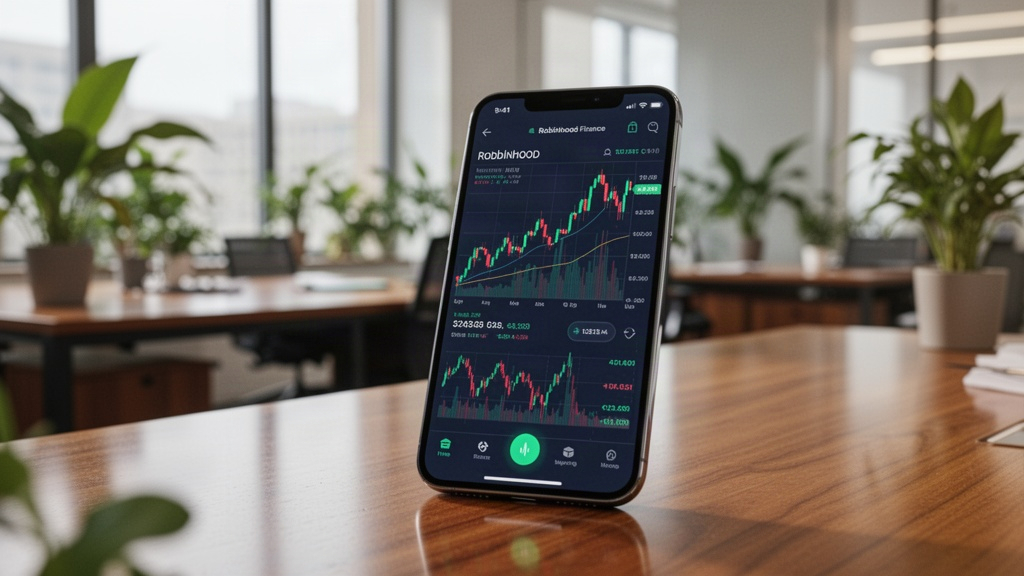
Robinhood Finance has reshaped how everyday investors approach the stock market. Since its launch, Robinhood Markets, Inc. has attracted millions of users by stripping away the barriers that once kept retail investors on the sidelines. Whether you are a first-time trader or someone looking to simplify an existing portfolio, the platform offers a compelling mix of accessibility, cost efficiency, and modern features. With over 3 million active users and steady year-over-year growth, Robinhood has earned its place as one of the most discussed trading platforms in the United States. This article breaks down the five strongest reasons traders continue to choose it, backed by concrete data and an honest look at what the platform actually delivers in practice.
A Trading Platform Built for Every Skill Level
One of the most consistent complaints about traditional brokerage accounts is the steep learning curve. Platforms designed decades ago carry that legacy in their interfaces: cluttered dashboards, dense menus, and jargon that alienates beginners. Robinhood took a different path from day one, building a mobile-first experience that prioritizes clarity over complexity.
The app presents stock charts, portfolio performance, and order execution in a single, scrollable view. A new user can fund an account and place their first trade within minutes. That speed is not accidental — the design team at Robinhood has consistently iterated on reducing friction between intent and action. For someone who has never bought a share before, that matters enormously.
Accessibility goes beyond the interface. Robinhood requires no account minimum to get started, which removes a financial barrier that still exists on platforms like Fidelity or Charles Schwab for certain account types. A student with $20 can participate in the same markets as a seasoned investor with $200,000. That democratization of market access is not just a marketing angle — it reflects a genuine structural shift in who gets to trade.
The platform also provides educational content directly within the app, including explainers on options, ETFs, and dividend investing. These are not hidden behind a paywall or buried in a help center. They appear contextually, when a user is looking at a relevant asset. That kind of integrated learning shortens the gap between curiosity and competence, making Robinhood genuinely useful for traders at the start of their journey.
Mobile trading has also evolved significantly. Push notifications, price alerts, and earnings reminders keep users informed without requiring them to monitor screens all day. For someone managing a portfolio alongside a full-time job, that passive awareness is practical rather than gimmicky.
Zero-Commission Trading and Its Real Financial Impact
The number that changed the brokerage industry is simple: $0 in commissions per trade. When Robinhood introduced commission-free trading, it forced legacy brokerages to follow suit. Today, many competitors have eliminated commissions too, but Robinhood built its entire model around this principle from the start.
The practical difference adds up faster than most traders expect. On a traditional platform charging $6.95 per trade, an investor making 20 trades per month pays $1,674 annually in commissions alone. That money stays in the account on Robinhood, compounding alongside the rest of the portfolio. Over five or ten years, the difference in outcomes becomes substantial.
It is worth being transparent about how Robinhood generates revenue without charging commissions. The company uses a practice called payment for order flow (PFOF), where market makers pay Robinhood to route trades through them. The Securities and Exchange Commission (SEC) has scrutinized this model, and traders should understand that PFOF can result in slightly less favorable execution prices in some cases. That said, for most retail trades, the impact is negligible compared to the savings from zero commissions.
Robinhood Gold, the platform's premium subscription tier, adds margin trading, larger instant deposits, and access to professional research reports for a monthly fee. This optional layer lets users scale up their capabilities without forcing everyone to pay for features they do not use. The base product remains free, which keeps the platform honest about its value proposition.
For frequent traders, the absence of per-trade fees also changes behavior in a productive way. Investors are more willing to rebalance portfolios, take partial profits, or exit losing positions when there is no transaction cost creating inertia. That flexibility, priced at zero, is one of Robinhood's most underappreciated advantages.
What Makes Robinhood Finance Stand Out Technically
Beyond cost, Robinhood Finance has built a feature set that competes with platforms targeting more experienced traders. Fractional shares are one of the clearest examples. Rather than needing $180+ to buy a single share of a high-priced stock, users can invest any dollar amount and receive a proportional slice of that share. A $10 investment in a $500 stock gives you 2% of a share, with full exposure to price movements and dividends.
This feature has practical consequences for portfolio diversification. An investor with $500 can spread exposure across 20 different companies rather than being forced to concentrate in whichever stocks happen to fall within their budget. That kind of flexibility was previously available only to institutional investors or those using specialized tools.
Cryptocurrency trading is integrated directly into the Robinhood app, covering assets like Bitcoin, Ethereum, and Dogecoin without requiring a separate account on a crypto-specific exchange. While Robinhood's crypto offering does not include wallet transfers to external addresses for all assets, recent updates have expanded functionality in this area.
The platform also offers options trading with a relatively straightforward interface for basic strategies. Experienced traders can execute calls, puts, and multi-leg strategies. Beginners get guided flows that explain the mechanics before confirming an order. That dual-track approach serves both audiences without compromising the experience of either.
Recurring investments represent another practical feature. Users can schedule automatic purchases of stocks or ETFs on a daily, weekly, or monthly basis, building a dollar-cost averaging strategy without manual intervention. Set it once, and the account grows on autopilot.
Regulatory Oversight and the Safety of Your Funds
Robinhood Markets, Inc. operates under the oversight of two major U.S. regulators: the Securities and Exchange Commission (SEC) and the Financial Industry Regulatory Authority (FINRA). Both bodies set conduct standards, require regular financial disclosures, and provide recourse mechanisms for investors. Trading on a FINRA-registered broker-dealer means your account benefits from established dispute resolution processes.
Cash and securities held in Robinhood accounts are protected by the Securities Investor Protection Corporation (SIPC), which covers up to $500,000 in securities and $250,000 in cash per account in the event of broker failure. This protection does not cover investment losses from market movements, but it does address the scenario where the brokerage itself becomes insolvent.
Robinhood has faced regulatory scrutiny in the past. A 2020 fine from FINRA related to best execution practices and misleading communications was a significant moment for the company. Since then, compliance infrastructure and customer communication standards have been visibly strengthened. The platform now provides clearer disclosures around options risk and margin requirements.
Two-factor authentication, biometric login, and encryption protect user accounts at the technical level. For users concerned about account security, these features align with what major financial institutions offer. Robinhood also monitors accounts for suspicious activity and alerts users to unrecognized login attempts in real time.
No brokerage is without risk, and Robinhood's history of outages during high-volatility periods — most notably in March 2020 — raised legitimate concerns about platform reliability. Infrastructure investments since then have improved stability, but traders who execute time-sensitive strategies should factor this history into their platform choice.
How Robinhood Compares to Other Major Trading Platforms
| Platform | Commission per Trade | Fractional Shares | Crypto Trading | Account Minimum | Options Trading |
|---|---|---|---|---|---|
| Robinhood | $0 | Yes | Yes (integrated) | $0 | Yes |
| Charles Schwab | $0 | Yes | No | $0 | Yes |
| TD Ameritrade | $0 | No | No | $0 | Yes |
| E*TRADE | $0 | No | No | $0 | Yes |
| Webull | $0 | Yes | Yes | $0 | Yes |
The table above shows that while commission-free trading is now an industry standard, Robinhood's combination of fractional shares, integrated crypto, and a $0 minimum remains a competitive package. Webull offers similar features, but Robinhood's user base and brand recognition continue to attract new investors who want a familiar, well-documented experience.
For traders who prioritize advanced charting tools or in-depth research, platforms like Charles Schwab or TD Ameritrade may offer more depth. Robinhood's strength is not in raw analytical firepower — it is in removing every unnecessary obstacle between a trader and their next move. That focus on simplicity, combined with zero-cost execution and a growing feature set, explains why the platform continues to grow at roughly 5% annually in active users despite operating in an increasingly crowded market.
Choosing a trading platform is ultimately a question of fit. Robinhood fits traders who value speed, simplicity, and cost efficiency over exhaustive research tools. For that profile, it remains one of the strongest options available in the U.S. market today.